Recommended Flies for Each Month 1885
North Country Spiders 1883
When the Fishing Gazette was first established in 1877 the editor and owner was FW Allen. The following year, Mr RB Marston became the Editor and in January 1878 became the owner of the company. In the meantime, while still working as a full-time travelling Chemist selling dyestuffs for the Leeds cloth industry, Francis Walbran became a regular contributor of articles to the angling press and letters to local newspapers. The Fishing Gazette printed his early articles under the heading ’Angling Resorts on the Yorkshire Rivers’; these locations included Hackfall, Mickley, Tanfield and Masham. He and Marston became life-long friends and fourteen years later, Marston was to become an honorary member of Tanfield Angling club at its foundation in 1892.
Many fly fishers believe that the Red Tag was a Grayling pattern invented by Walbran, but research indicates that this was not the case. In 1896 the Fishing Gazette published a short article by Walbran (right) in which he explains the origin of the fly and how he became associated with it in 1880. In October 1885 he described the details of the pattern and mentions that he believed the pattern to have been invented by ‘an angler named Wheatley’. (See separate article on his recommended patterns in 1885.)
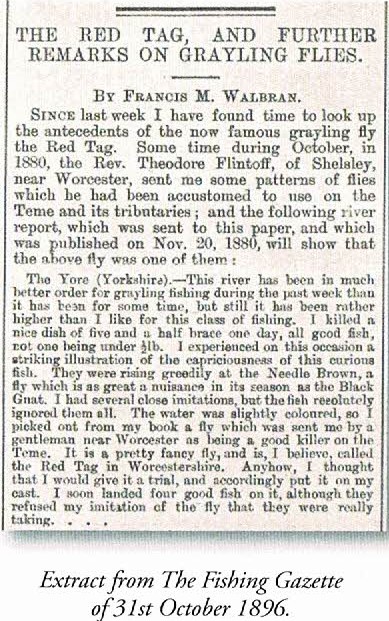
The author Harwood Brierley is likely responsible for this confusion. Eight years after Walbran’s November 1880 report, Brierley published a glowing tribute in the 1904 Fishing Gazette, referring to Walbran as the “patentee” of Walbran’s Red Tag. When Walbran tragically drowned less than two years later, Brierley’s recent article would be far fresher in the public’s memory than the original 1880 account, thereby cementing the misconception.
In October 1883, Walbran reported in the Fishing Gazette that “a growing number of experienced fishermen accustomed to the slow running chalk streams of the South, where they would expect to catch large numbers of trout and grayling, were expressing their disappointment in catching far fewer fish in the Yorkshire rivers”. This led him to politely explain that their ‘ill luck’ was not due to their lack of skill in casting, their use of inferior equipment or the need for extreme caution when wading upstream, but that their fly patterns had been completely wrong’. He went on to say that, as a rule, winged flies ‘whose feathers would become like a mere thread’ were of little use in rapid streams; whereas a simple hackled fly (or spiders as they are termed in the north) expands its fibres in the rough water and presents a more attractive appearance to the feeding fish.’
He pointed out that the terminology for flies in the north is based largely on the feathers and silks of which they are composed and although they may appear to have ‘fancy’ names, they are in reality, good imitations of leading aquatic insects, and should not be dressed too heavily.
In just one article he recommended the following twelve flies that ‘Mr W J Cummins of Bishop Auckland’ had recently displayed at an exhibition in South Kensington, and gave their patterns. In March 1885, Mr Cummings became Walbran’s official fly tyer of his patterns which he (Cummins) would sell in a minimum quantity of 6 to all enquirers. When Walbran opened his shop near Leeds station in 1888, the flies he sold were all tied by Cummins. He never claimed to have invented these patterns himself. The flies and patterns are reproduced here along with his comments on their use. It is interesting to note his deep understanding of entomology and the insects he describes.
(1) “Woodcock and Orange.” — Body, head, and shoulders, orange silk, waxed; wrap in a few fibres of dark red-brown mohair for legs and hackle, with feather of double shade of colour from under wing of woodcock. Remarks: This is an excellent fly to use during the early spring months. It represents the clans of flat winged browns that come thickly upon the water about that time. It may also be employed with advantage during August and September.
(2) “Snipe and Yellow.” — Body, head, and shoulders,–pale yellow silk, slightly waxed, and dubbed very sparingly with water-rat’s fur, hackled with feather from under a snipe’s wing. Remarks: This fly is a great favourite with Yorkshire anglers, and is generally termed by them “snipe bloa,” the latter word signifying the colour of a cold, grey cloud from an old Saxon word; it no doubt is taken by the fish as representing flies of the blue dun type. I am acquainted with one highly successful Wensleydale angler who never makes up a cast of flies without his favourite “snipe bloa” and he tells me that he kills a good share of his fish with it throughout the entire season.
(3) “Dotterel and Yellow.” — Body as in the preceding fly, hackled with the golden-tipped feather from a dotterel’s wing. Remarks: This is a capital imitation of the yellow dun, and if faithfully dressed with real dotterel’s feathers, cannot be sur-passed as a point fly in April and May. I may add that Mr. Cummins always supplies the correct pattern if specially requested, but charges a slightly increased price, dotterel’s feathers being so difficult to procure.
(4) “Waterhen and Orange.” — Body, head, and shoulders, orange silk, hackled with breast feather from a water-hen. Remarks: Commonly known in Yorkshire as the “dark watchet,” but is in reality a representation of the iron-blue dun. I have known some capital dishes result from the proper use of this fly.
(5) “Blue Partridge.” —Body, slaty blue silk slightly waxed, hackled with the light mottled feather from a partridge. Remarks: This is a standard fly upon the Wharfe. It is evidently intended as an imitation of the sand gnat or spider fly. In April and May it is an excellent killer, and recently, on the Yore, I killed four grayling with it in October.
(6) “Orange Partridge.” —Body, orange silk, waxed, hackled from the mottle& feather from a partridge. Remarks: This is another pattern that Wharfedale anglers swear by and it certainly is a splendid killer during almost the whole season. During the earlier months it is no doubt taken for the March brown; and as that fly is upon the water subsequently in the different forms of May brown, August dun, etc., it is easy to understand why it is such a universal favourite.
(7) “Landrail and Yellow.” — Body, yellow silk, hackled from a landrail’s wing feather. Remarks: A good autumn fly; taken, no doubt, as the Cinnamon and others of the Phryganidae, which are to be found thickly upon the water at that period of the year. This fly kills the best upon a showery day.
(8) “The Stone Midge.” — Body, lead-coloured silk and heron’s harl, hackled with the green-coloured feather from a plover’s neck. Remarks: A good fly during April and the early portion of May.
(9) “The Knotted Midge.” — Body, lead-coloured silk, dubbed with fur from a fox’s ear; hackled with feather taken from between wings and body of a green plover; to be dressed upon No.00 hook. Remarks: This is the “Tail to Tail” mentioned by Mr. Aldan in his “Quaint Treatise.” His dressing, however, materially differs from the above, and is as follows:—Body. dark fawn- coloured silk, ribbed with harl from a brown turkey’s tail, hackled from a sooty-black hen’s feather. Mr. A. gives an instance, when upon the Derbyshire Derwent, he and a friend killed a splendid dish of trout, when several other anglers could do nothing, and assigned the reason of their ill-luck to “thunder in the air,” “too much water,” and other well-known anglers’ excuses. I have found the above pattern of Mr. Aldam’s to be all that can be desired, and, if anything, superior, to the usual Wharfedale pattern.
(10) “The Musk Fly.” — Body, orange silk, with a single turn of peacock’s herl for the head, hackled with feather from outside of an owl’s wing. Remarks: Generally styled “Brown Owl” by the frequenters of Wharfedale; it really represents the “Little Brown Silverhorns” of Francis, and when the natural insect is dancing up and down upon the surface of the streams upon a fine autumn evening no better imitation can be employed.
(11) “The Fog Black.” —Body, purple silk, waxed, hackled with feather from a bullfinch’s wing. To be dressed small; upon a No.0 hook. Remarks: A capital fly for grayling during the autumn months, when it is taken for the numerous class of small black flies which may be found upon the water at that period of the year.
(12) “The Willow Fly.” —Body, mole’s fur spun on yellow silk, hackled with a grizzled hackle of a copperish hue. Remarks: A splendid autumnal grayling fly. I have known days upon which no other fly was of any avail.
Recommended Fly Patterns for Each Month 1885
In the 7th March 1885 edition of the Fishing Gazette, Francis Walbran told his readers that he would produce a monthly list of six to eight trout and grayling flies that he knew, from his ‘own experience and trusted sources, to be suitable for each month on Yorkshire rivers and elsewhere’. He stressed the importance of hook size and the colour of the flies and stated that he never used a hook larger than a No.1 (size 14 in today’s scale) and sizes No.0 (16) or 00 (18) being required in some cases.
The text below is as close as sensibly possible to Walbran’s original as printed in the Fishing Gazette, but with some of his lengthier comments on his experiences with the flies edited or omitted. A few of the pattern details given may include slight amendments from the original which Walbran gave, in response to queries sent in by his readers.
Seven Patterns for March (Fishing Gazette 7 March 1885)
No. 1. THE RED FLY.—Body: Orange floss silk, ribbed with bronze peacock’s herl, over which wind a (natural coloured) blood-red hackle from bend to point, using brown silk for tying purposes. Hook No. 1.
During the whole of March you cannot employ a better fly than the above at the point of your cast
No. 2. THE DARK BLOA.—Wings: From the dark feather inside of a water-hen’s wing. Body: Dark red brown silk. Legs: Blue grizzled cock’s hackle stained black in onion dye. Tail: Two strands of the same. Hook No. O.
This is one of the earliest flies of the upwinged Dun class that comes upon the water. It usually answers best upon cold, gloomy days. Under such circumstances, I have often had very good sport with this pattern.
No. 3. THE OLIVE BLOA: – Feather from starling’s quill, dyed in onion-peel water. Body: Light Olive silk, waxed; then untwist and wrap on in alternate rings of waxed and unwaxed silk. Legs: Olive-stained hackle. Tail: Two strands from a rabbit’s whiskers. Hook No. 0.
When properly dressed this is the best fly you can possibly use during this month. Some anglers use a little dubbing in the form of fur from a hare’s ear, but the above plan (for which I am indebted to Mr. Francis Francis) is incomparably the best. John Jackson (of Tanfield Mill) thinks that this fly is the female of the Dark Bloa, but on this point I am not inclined to agree with him.
No. 4. THE EARLY BROWN.—Body: Orange silk waxed, hackled with feather of double shade from under a woodcock’s wing, a few fibres of dark red brown mohair being worked in at the breast. No. 0 hook.
This pattern is an excellent one, and is generally termed “inside woodcock” by Yorkshire anglers. It represents the flat-winged browns, which in open weather may be found upon the water even in February. It is as well to dress the same way with a feather from outside of a woodcock’s wing, and fish both patterns upon the same cast, as sometimes the trout prefer the darker shade and at others the light.
No. 5. THE BLUR MIDGE.—Wings: Feathers from a landrail’s back. Legs: Grizzled hackle. Body: Lead-coloured silk. Hook No. 00.
This diminutive insect is often very useful upon a moist, drizzling kind of day either during March or in the late autumn; in the latter case the grayling frequently take it with avidity, the only fault to be found with it being the extremely small hook upon which it must be dressed. However, when this or any other midge fly is upon the water, the fish—either trout or grayling will seldom take any other larger pattern; consequently, I argue that it is better to basket even a single brace than return home with an empty creel.
No. 6. THE BROWN BEETLE.—Body: Bronzy peacock’s herl and brown silk, over this hackle on a glossy feather from a starling’s neck. Hook No. 0.
This is an excellent point fly for early spring. I prefer it myself to the famous Black Spider handed down to posterity by the late Mr. Stewart, and most old anglers know the deadly qualities of that fly. Both this pattern and No. 1 must always be employed at the end of your cast.
No. 7. THE MARCH BROWN.—Wings: Feather from the back or tail of a partridge. Body: Ruddy brown silk ribbed with olive. Legs: Grey feather from a partridge’s back. Tail: Two strands of the same. No. 1 hook.
For my own part, I consider this a decidedly overrated fly, and I am pleased to say that my opinion is also entertained by one of the beat fly-fishers who ever threw line–I refer to the late Jno. Jackson, of Tanfield Mill. You may, perhaps, have an isolated day upon which the fish will rise well at the imitation, and I am well aware that many men of far more extended experience than myself would never dream of making up a cast of flies in March or April without it; but for all that, I agree with Mr. Jackson that the Olive Bloa, is a far greater favourite with the fish, and is, consequently, a far more indispensable fly. In cold, rough, windy weather, I always use a feather from outside of a woodcock’s wing, and rib the body with, gold twist.
These seven patterns are amply sufficient to kill trout during March upon any stream. I would recommend the angler to commence the season with No. 1 at point, and Nos. 2, 3, and 4 as droppers. About March 20th, employ No. 6 at point, in conjunction with Nos. 3, 4 and 7. As I remarked previously, No. 5 is most efficacious upon days inclined for rain during the whole of the month.
Six Patterns for April (Fishing Gazette 4 April 1885)
For April I intend to give six patterns only, and I think that your readers will find them amply sufficient, if used in addition to Nos. 3, 5, 6, and 7 from the list which appeared in the Fishing Gazette for March 7th.
No. I. ORANGE PARTRIDGE. – Body: Orange silk, waxed. Wings and legs made hacklewise, with the dark mottled feather from a partridge’s tail. Hook No. 0.
This is deservedly a very favourite fly with Yorkshire anglers, many of whom use it during the whole of the season. In cold, heavy weather, a yellow silk body in place of the orange dressing answers the best.
No. 2. THE SAND GNAT.—Body Slaty-coloured blue silk, dubbed sparingly with water-rat’s down. Wings and legs dressed hacklewise, with a feather from outside of a woodcock’s wing, near the butt—not too dark. Hook No, 0.
This fly is only met with on certain rivers, where long beds of sand and gravel run down to the water’s edge. On warm, sunny days such places may often be seen covered with this fly, which runs rapidly to and fro upon the sand; but directly the sun is obscured, or a cold wind arises, the whole tribe seem to vanish like magic. The Wharfedale anglers have a dressing for this fly, which they term the Blue Partridge, and which is a good killer upon the Wharfe; but upon the Yore the above pattern answers better.
No. 3. THE DOTTEREL DUN.—Body Yellow silk, ribbed in distinct rings upon a dubbing formed of light yellow mohair mixed with sufficient mole’s fur to give it a bluish tinge. Wings: The lightest portion of a young starling’s wing feather. Legs: A pale yellow dun hackle. Tail: Two strands of the same. Hook No. 0.
Also made hacklewise with a real dotterel’s golden-tipped feather wrapped upon the above body.
This is a capital fly when properly dressed. I prefer the latter-mentioned hackled pattern but owing to the scarcity of dotterel feathers, fly-dressers are very fond of substituting some other kind. This is a very reprehensible practice; for, as far as my experience goes, anglers are not usually men who grudge expense where their favourite sport is concerned, and would gladly pay a small extra charge than be imposed upon in the way that I have called attention to.
No. 4. THE IRON BLUE DUN. —Body: Water-rat’s fur, mixed with a very little purple mohair, ribbed with fine, pale-yellow silk, and a turn or two of reddish-brown floss silk to form the head. Wings: From the tips of feather taken from the breast of a water-hen, Legs: A very small honey dun hackle. Tail: A strand or two of the same. Hook No. 0.
No. 5. THE SAND FLY. – Body –Sandy-coloured fur from a hare’s neck spun upon silk of the same colour, hackled with a brown owl’s feather: to be dressed as flat as possible.
This fly kills well if fished at point on fine evenings during this month and the next.
6. THE GOLDEN PLOVER. – Body: Fur from a hare’s ear, dyed a darkish-
yellow and hackled with a small yelow mottled feather from the back of a golden plover. Hook No. 0.
This also is a good evening fly when the weather is warm and the water fine. I do not, however, consider it so indispensable as the preceding patterns in this month’s list.
Seven Patterns for May (Fishing Gazette 9 May 1885)
No. 1. THE OAK FLY.—Body: Orange floss silk; ribbed with lead-coloured ditto. Wrap a furnace hackle from tail to head, and then snip off the fibres to nearly where the wings are set on. Lastly, tie on the wings flat, using for them a feather from inside of a woodcock’s wing. Hook, No. 1.
This is an excellent fly to employ upon a thickly-wooded stream; but upon broad, open rivers like the Yore and Wharfe it is of very little use.
No. 2. THE LITTLE BLUE BLOA. – Body: Pale buff-coloured mohair, mixed with a very little water-rat’s fur. Wings: From a sea-swallow’s feather, set well up. Legs: Honey dun hackle. Tail: Two strands of the same. Hook, No. 0.
On warm evenings during May the surface of the water is sometimes covered with this gauzy-looking little insect, and in such cases it is as well to fish with three upon your cast at once; for a tail fly ’employing’ No. 3, April list—the hackle pattern.
No. 3. THE MAY BROWN.—Body: Olive silk, ribbed with light brown. Wings: Ruddy grey feather from a partridge’s back. Legs: Olive-stained hackle. Tail: Three strands of the same, Hook, No. 1.
I think that this fly is analogous to the Turkey Brown of Ronalds, although the latter gives rather a different dressing. It is a very useful fly, and I have frequently had very good sport with it upon the Yore. On the Wharfe and other Yorkshire streams I cannot say I have done much execution with it.
No. 4. THE LITTLE OLIVE BLOA.—Body: Olive silk, ribbed with pale lemon-coloured ditto. Wings; Light starling’s feather, dipped in onion dye. Legs: Blue dun hackle: Tail: Two strands of the same. Hook, No. 0.
This also is a good evening fly. It is taken best when the water is low and clear just before dusk.
No. 5. THE GROUSE HACKLE. – Body: Orange silk, tipped with gold tinsel; hackled with ‘the mottled’ feather from the back of a cock grouse. Hook No. 1.
A splendid killer in a brown ‘water, clearing after a fresh. Under such circumstances I have frequently seen the trout take this fly with such avidity that the whole of the feather has been torn away during the course of a few hours’ fishing.
No. 6. THE BRACKEN CLOCK.—Body: Red-brown silk, with at turn of bronze peacock’s herl, hackled with feather from corncrake. Hook, No. 1.
This fly is a most useful one upon almost any river. It is a great favourite of Mr. Cummins, the well-known Durham angler. He informs me that he uses it almost all the year round, and generally finds that it kills its share of fish. He was the first to bring it to my notice, and since I have tried it in Yorkshire, I am quite convinced of its merits.
No. 7. THE HACKLED DUN. Body: Pale yellow mohair, mixed with a little
dark fur from a hare’s ear, hackled with the short feather from under wood- cock’s wing, near the butt. Hook, No. 0.
A good fly for small streams, such as Skell, Laver, Codbeck, etc. It is most successful during a low, clear, state of the water.
No. 8. THE ORANGE FLY.—Body: Orange floss ribbed very neatly with green peacock’s herl; hackled with a couple of turns of a furnace hackle. Hook, No. 0.
This is essentially a fly for low water and, bright, sunny weather. Under such circumstances both trout and dace take it well and, in the autumn it is an
excellent pattern for grayling.
These eight patterns used in conjunction with Nos. 3, 5, and 6, April list, will be found I think, amply sufficient for this month.
Six Patterns for June (Fishing Gazette 6 June 1885)
No. 1. THE ORANGE DUN – Body: dark orange silk. Wings: dark portion of a starling’s quill feather. Legs: Dark dun hackle. Hook, No 1.
This is a capital fly in a clearing water; it also kills grayling well in the autumn.
No. 2. THE WREN TAIL – Body: Yellow silk, hackled with the small feather form a wren’s tail. Hook, No. 0.
A good fly for hot, bright weather. It kills best on small streams and sometimes a tag of gold tinsel is an additional advantage.
No. 3. THE GREEN MIDGE – Body: Gosling’ green silk, hackled with the pale blue feather from a sea swallow. Hook, No. 0.
A good evening fly used in conjunction with No2 May list. The shade of green is one recommended by Mr Aldam in his “Quaint Treatise on Flies”, and he remarks that the Irish name for this particular shade is “Bivenna”.
No. 4. TAIL TO TAIL – Body: Dark fawn coloured silk with the harl of a brown turkey’s tail twisted along with it, hackled with a sooty-black hen’s hackle (from the ruff). Hook, No. 0.
I am Indebted to Mr Adam for the dressing of this fly, which is equivalent to the Wharfe pattern styled the Knotted Midge.
No. 5. THE BLACK MIDGE – Body: A shiny black horse’s hair wound neatly on. Wings: Starling’s light quill feather, set well up and divided. Hook, No. 0.
Mr RB Marston has facetiously christened this fly the “ angler’s cuss”, and a very appropriate title it is; a greater pest does not exist, for the river may be boiling with rising fish, and unless you have a good imitation, you may as well throw your hat in.
No. 6. THE BARM FLY – Body dressed full, with light, creamy-brown fur. Legs: Red hackle. Wings: Dark speckled cock pheasant. Hook, No 2.
This fly represent a numerous class of insects which appear at dusk and frequent the long grass at the edge of rivers; it should be used as a tail fly, and thrown well in at the edge and under overhanging branches.
July (Fishing Gazette 18 July 1885)
For Bustard Fishing (Dusk and dawn fishing in Westmoreland & Cumberland)
THE WHITE BUSTARD. – Body; White Berlin wool, short and full. Legs: two turns of white hen’s hackle. Wings: From the quill feather of a white Pigeon; at the tail tie in a small tag of white leather. Hook No. 2 or 3.
THE YELLOW BUSTARD. –Body; Light yellow mohair, ribbed with red silk. Legs and wings: A soft hackle died yellow, struck from head to tail. Tag of white leather at tail. Hook No. 2 or 3.
In the same article:
Six Patterns for July (Fishing Gazette 18 July 1885)
To these add Nos 3, 4 and 5 from the June list.
No. 1. THE RED ANT. – Body: Red-brown silk, with a single turn of bronzy-green peacock’s harl at the tail. Legs: Red cock hackle. Wings: Dressed small from the light, shining portion of a starling’s wing. Hook No. 0.
This fly is a very great favourite of mine, especially for grayling during August and September. The generality of patterns are dressed far too large, which is a great mistake, the natural fly being only a small one. I always employ it as a top dropper. With the addition of a maggot it is a capital fly for the young beginner to whip for dace with.
No. 2. THE BLACK ANT. – Body: Black horsehair, with a single turn of ostrich and peacock’s harl twisted together. Legs: Black cock’s hackle. Wings: Dressed small from the darker portion of a starling’s wing. Hook No. 0.
Although not such a killing pattern as the preceding, still at times I have found this an excellent fly.
No. 3. THE BLUE MIDGE. – Body: Slate blue silk, hackled with a pale silvery-blue hen’s hackle. Hook: No. 00.
When this class of fly is on the water the fish will rarely look at any larger insect; it is therefore, a good plan to make up a cast of three flies only – viz; this one at point; No. 4 June list as second dropper; and No.5 June list, as top dropper.
No. 4. LIGHT SILVER HORNS. – Body: Light brown silk, dubbed with a little water rat’s fur. Legs: Grizzle hackle. Wings: landrail quill feather, with four strands of grey mallard to imitate the white spots. Horns: Grey mallard. Hook No. 1.
This and the following pattern are splendid flies for evening fishing.
No. 5. BLACK SILVER HORNS. – Body, Black ostrich harl, ribbed with silver wire. Legs: Black hackle. Wings: Outside of waterhen’s wing, with four strands of grey mallard to imitate the white spots. Horns: Grey mallard. Hook No. 1.
No. 6. THE PALE SILVER DUN. – Body: silvery grey silk. Legs: Pale blue dun. Wings: Light starling. Hook No. 0.
Another excellent evening fly; in fact as I remarked before, unless in a coloured water, or on a dull day with a breeze on the water, it is practically very little use fly-fishing in the daytime. This fly is termed the Ashy Dun in some districts, most probably for the reason that in colour it resembles the bark of an ash tree. I may here remark that the wings of this fly should be dressed as upright as possible, and those of the two varieties of silver horns (above) flat to the body.
Six Patterns for August(Fishing Gazette 15 August 1885)
No. 1. THE AUGUST BROWN. – Body: Light brown silk dubbed sparingly with hare’s face, and ribbed with yellow silk, dresses hacklewise with grouse’s feather. Hook No. 1.
This fly is quite as good during August and September as the March Brown is during its season; in fact, I am strongly of opinion that it is only a later edition of the last-mentioned fly.
No. 2. CINNAMON FLY. – Body: Fawn-coloured floss silk, made hacklewise, with feather from brown owl’s wing. Hook No. 1.
For evening fishing I know of no better fly than this; it is a special favourite of mine, and I never make up a cast during August and September without having one at point.
No.3. BLUEBOTTLE. – Body: Black ostrich harl and blue tinsel twisted together, and tied at the shoulders with fawn-coloured floss silk; dressed hackle-wise with a dark dun hackle. Hook No. 1.
An excellent fly during August and September, when they are becoming weak and fall upon the water. The natural fly is also very effective fished with fine tackle over the bushes of trout deeps.
No. 4. ORANGE STINGER. – Body: Head portion brown silk. Tail: orange floss silk, tied in small at the middle. Wing: Feather from a starling’s quill. Legs: Furnace hackle. Hook No. 1.
Orange Fly of Ronald’s; an excellent grayling fly on the Yore, but never found it answer well upon other Yorkshire rivers.
No. 5. PALE EVENING BLOA. – Body: Pale blue fur and a small portion of yellow mohair, well mixed; made hacklewise with feather from a sea swallow. Hook No 1.
Similar to the pale duns in June and July lists; good late in the evening of hot, sultry days.
No.6. SMOKE FLY. – Body: Bronzy-brown peacock’s harl, hackled with feather from a young grouse. Hook No. 1.
A standard Wharfe fly, and a deservedly popular favourite with the local hands; it is a similar fly to the Derbyshire “Little Chap”
Six Grayling Patterns for September (Fishing Gazette 12 Sept 1885)
I will now give a list of six patterns of flies suitable for grayling fishing during September, in addition to which may be added No.’s 2, 4, and 6, in the August list.
I can confidently recommend these patterns, and should my readers find that they are unable to obtain sport by a selection from them, I am afraid that it will be of little use for them to continue to fly fish on that occasion.
No. 1. THE HONEY DUN BUMBLE. – Body, Peacock harl, ribbed with orange floss silk; hackled with a pure honey dun hen’s hackle; tying silk, claret. Hook No.1.
A splendid fly for grayling, and prime favourite upon the Derbyshire streams; to be fished as a point fly.
No. 2. THE MULBERRY BUMBLE. – Body, peacock’s harl, ribbed with mulberry-coloured floss silk, hackled with a dun hen’s hackle; tying silk, claret. Hook No.1.
No. 3. THE GREY PALMER. – Hackled with a cock’s hackle, having a grey centre and a whitish-grey edge; ribbed with fine, round silver tinsel. Tying silk, black. Hook No.1.
This is a capital fly. I have had a splendid sport with is in both Yorkshire and Derbyshire.
No. 4 THE FOG BLACK. Body, dark purple silk, dubbed very sparingly with black ostrich harl; wings, from a bullfinch’s wing. Legs from a starling’s neck. Hook No.0.
A standard grayling fly upon the Wharfe; on dull damp days and cold, misty evenings it answers well.
No. 5 THE FURNACE HACKLE. Body, orange floss silk, ribbed with green peacock’s harl, and a Furnace hackle wound round twice. Hook No.1.
An excellent killer at point in low, clear water.
No. 6 THE DARK OLIVE BLOA. – Body, ruddy brown silk; wings, from the dark part of a waterhen’s wing, set well up and divided; legs, honey dun hackle. Hook No.1.
A great favourite of mine as a top dropper. I have killed some good dishes of grayling with this fly alone.
Six Grayling Patterns for October (Fishing Gazette 3 October 1885)
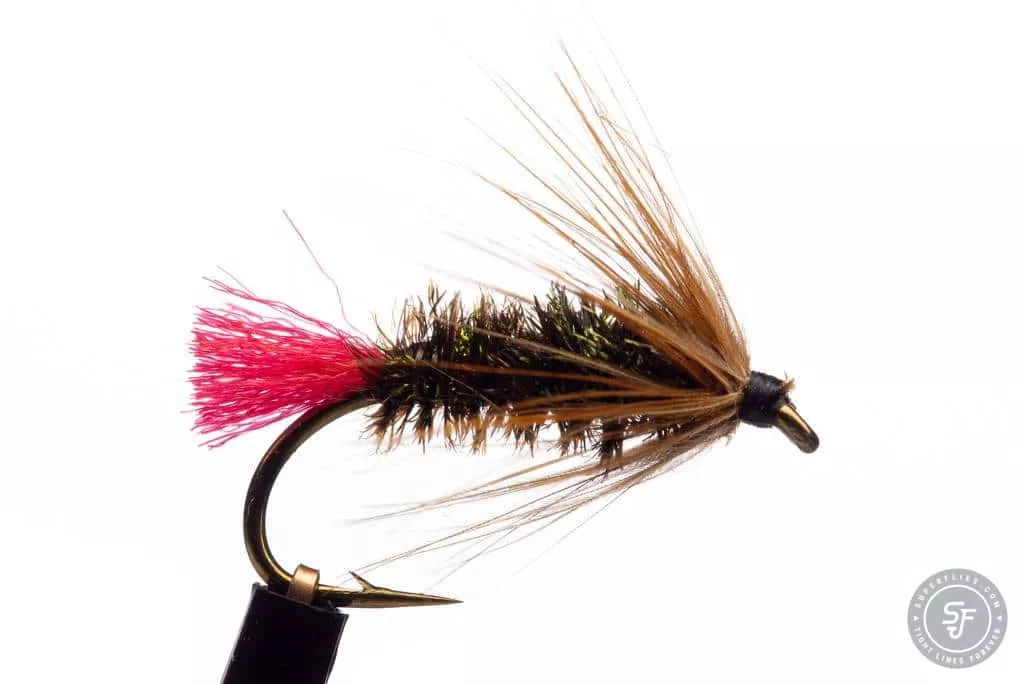
No. 1. THE RED TAG. – Body, green peacock’s harl, hackles with a red cock’s hackle, and a tag of crimson wool at the tail; tying silk, crimson. Hook No.1.
This fly was originally invented, I believe by an angler name Wheatley. It is an excellent killer on deep, eddying flats – especially when there is a scarcity of natural fly on the water; grayling generally take it a few inches below the surface.
No. 2. THE WATERHEN BLOA. – Body, Yellow silk, dubbed with a water-rat’s fur, hackled with feather from inside a waterhen’s wing. Hook No.1.
If there is one fly more than another upon which I pin my faith when grayling fishing during cold, windy days ion thee autumn, this is the one; I never fail upon such occasions to give it a trial, and am seldom disappointed. Sometimes trout will also take it during September or in early spring.
No. 3. THE DARK NEEDLE FLY. – Body, orange silk, hackled with a feather from the darkest part of a brown owl’s wing, a turn of peacock’s harl to form the head. Hook No.1.
Another excellent fly for grayling; chiefly serviceable on cold, dull days, with occasional glints of sunshine.
No. 4. BRADSHAW’S FANCY. – Body, peacock harl, tied with crimson silk to show at the head, with a single turn harl over it, hackled or winged with a feather from a Norwegian crow, and a tag of crimson wool at the tail. Hook No.1.
This is purely a fancy fly. The pattern was devised by my friend Mr Bradshaw of Ilkley, who has killed a lot of grayling with it, both on the Rye and the Wharfe.
No. 5. THE BLUE MIDGE. – Body, lead-coloured silk, wings, set upright from waterhen’s neck; legs, grizzled hackle. Hook No.0.
A capital killer on moist, dull days. The pattern is Jackson’s, who was in his day one of the most skilful fishermen on the Yore. He states that on 16 December 1851, he killed eleven large grayling, partly with this fly, the weather at the time being fine and open.
No. 6. SMALL OLIVE BLOA. – Body, yellow silk, waxed; wings, starling’s quill feather, dyed in onion dye; legs, olive stained hackle; tail, two strands of the same. Hook No.1.
Another of Jackson’s patterns, and a good killer on the Yore.
Recommended Flies 1888
When Francis Walbran opened his fishing shop in Leeds in 1888, he produced a fly wallet for sale. In it he included a list of flies which he recommended for the Yorkshire rivers. In 2015 Robert L Smith wrote ‘The Yorkshire Fly: Yorkshire’s Soft Hackle Tradition’. In it he provides a list of the flies that Walbran recommended at that time. Below is the list as quoted in Smith’s edition.
Francis Walbran List 1888
(Names and descriptions for using standard patterns of flies used upon the Wharfe, Yore, Rye, Nidd and other celebrated trout and grayling streams.)
No. 1 The Spring Black
A general fly to employ during March when there is no particular fly upon the water. Mr Pritt mentions in “North Country Flies” that it is a good fly for Ullswater.
No. 2 The Winter Brown
An excellent early fly on the Wharfe; good in clearing water during the whole of March and April.
No. 3 The Warterhen Bloa
This is a certain killer in cool, dull days in early spring and in the autumn; dressed with quill then it is an excellent Grayling fly.
No. 4 Dark Snipe and Purple
An excellent fly for dull, cold weather during early spring and autumn.
No. 5 The Dark Bloa
Another useful spring fly; for autumn Grayling fishing I dress it smaller and with an apple green body.
No. 6 Snipe Bloa
An indispensable fly upon the Yorkshire rivers; I know several first-rate fly fishers who use it constantly throughout the entire season.
No. 7 The March Brown
This fly is so universally known that it seems un-necessary to make any remarks upon it, except that it is as well to use both the dark and light shades, which represent respectively the male and female flies.
No. 8 Yellow Legged Bloa
Synonym – Dotterel and Yellow; an excellent fly to use during March and April.
No. 9 Orange Partridge
A standard pattern and used throughout the entire season. Kills best at point.
No. 10 Blue Partridge
Another very killing pattern during April and May, especially in a full clearing off water, it represents the sand gnat or spider fly. It sometimes kills well again under similar circumstances during August. Kills best at point.
No. 11 Yellow Partridge (Dark)
A good general fly; sometimes kills well in June as an evening fly.
No. 12 Yellow Partridge (Light)
A good killer during April and May, and as an evening fly during the summer months.
No. 13 Orange Grouse
A splendid fly in clearing water, March, April and August are the best months to employ this fly
No. 14 Poult Bloa
A good killer throughout the entire season on cold dull days. The natural fly is often very strong upon the water during August and September.
No.15 Stone Bloa
A capital evening fly from the commencement of June to the end of the season.
No. 16 The Knotted Midge
A useful fly during dull thundery days in summer or when trout and grayling are “midging” in the autumn.
No. 17 The Stone Midge
Good all through the summer months.
No.18 The Brown Owl
Best as an evening fly from June to the end of the season.
No. 19 Yellow Dotterel
This hackle fly represents a great number of pale dun found upon the water during summer; it is sometimes dressed with an orange body.
No. 20 Dark Snipe and Orange
Kills sometimes on dull cold days during summer, but is best in autumn.
No.21 Small Ant
A first-rate killer during August and September.
No. 22 The Smoke Fly
A similar fly to the Derbyshire “Little Chap” and iss an excellent Grayling fly during the autumn months. Kills best as a point fly.
No. 23 The Light Watchet
A useful evening fly during summer.
No. 24 Dark Watchet
A standard Wharfedale pattern intended to represent the Iron Blue Dun; good from the middle of April to the end of May; will frequently kill Grayling in the autumn.
No. 25 Bracken Clock
An excellent trout fly in bright sunny weather.
No. 26 Dark Spanish Needle
An excellent killer in spring and autumn; during the latter season grayling frequently take it well, especially on damp cold days.
No. 27 Light Spanish Needle
Another edition of No.26, and more suitable for warm weather.
No.28 The Sand Fly
This fly is taken on dull windy days in April and May. Mr Pritt mentions in his book “North Country Flies” that it kills well on the Ribble.
No. 29 The Fog Black
Kills well from June to end of season, and is a good autumn Grayling fly. The natural insect is bred in the short grass after mowing, which in Yorkshire is termed “fog” – hence its name.
No. 30 Cinnamon Fly
A universal favourite in the North, and is best taken in the evening during July, August and September. Kills well after a shower.
No. 31 August Brown
Kills as well in its season as the March Brown, which it much resembles, being I fancy, a later edition of that fly. It is rather lighter and smaller. (Courtney Williams, in his 1949 ‘Dictionary of Trout Flies’ gives the dressing for this fly as: Body: light brown floss silk, ribbed with yellow. Legs; brown hackle. Tail; two rabbit’s whiskers. Wings: from a cock pheasant’s wing feather. Hook; 12 to 14.)
No. 32 The Willow Fly
A good autumn pattern for such rivers as the Wharfe and Yore, where willow trees abound.
No. 33 The Blue Midge
An excellent fly in dull, drizzly weather during early spring or late autumn.