
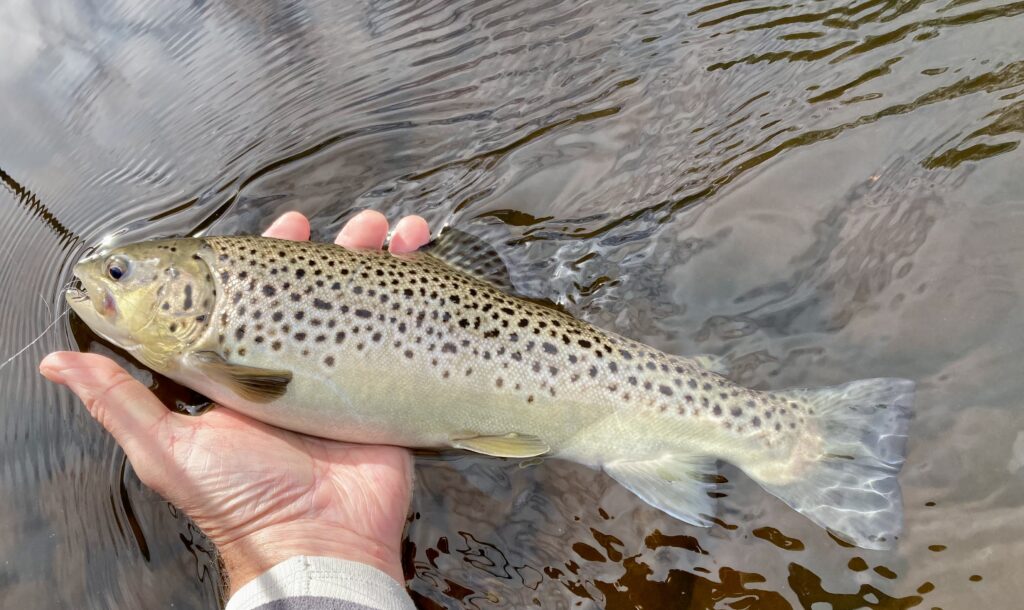
Our second visit of the year to the magical Ure at West Tanfield was right at the end of the trout season, though I was hopeful for the grayling being up, feeding on late season hatches. It has been so dry this year that it was hardly a surprise to find the river so low, and initially I was disappointed not to observe Pale Wateries and Blue Winged Olives.
In the absence of rises I elected for a duo rig up at Mowbray for my first, short session. The trusty Oppo on a dropper and equally trusty Hydro Caddis jig on point, brought an immediate response to the nymph in the form of a stunning two pound plus trout. Soon after, I lost another and thought that would be the end of it, and would require a move. I find the Ure hereabouts very difficult to wade, on the slippery, uneven boulders, so decided instead to ‘work’ the run-in more methodically. There is room to manoeuvre here, even though it requires faith.
To be clear, this run-in breaks into the pool at Mowbray and forms a fan of fish-holding water, with a well defined (even in low water conditions) crease between the deeper, slacker water and the boulders and gravel on the far bank. The flow then forms a very distinct foam lane which extends far down the pool, close to the far bank, before dissipating over the deep water. In all, the ‘percentage’ water, where you might be expected to catch most easily, is long enough and requires very little movement of the feet. You should avoid moving too far into the pool, because the gravel suddenly gives way and you find yourself slipping down into the blackness. Rather, work yourself very slowly upstream, and fan cast to an extent so as to exploit all the drift possibilities.
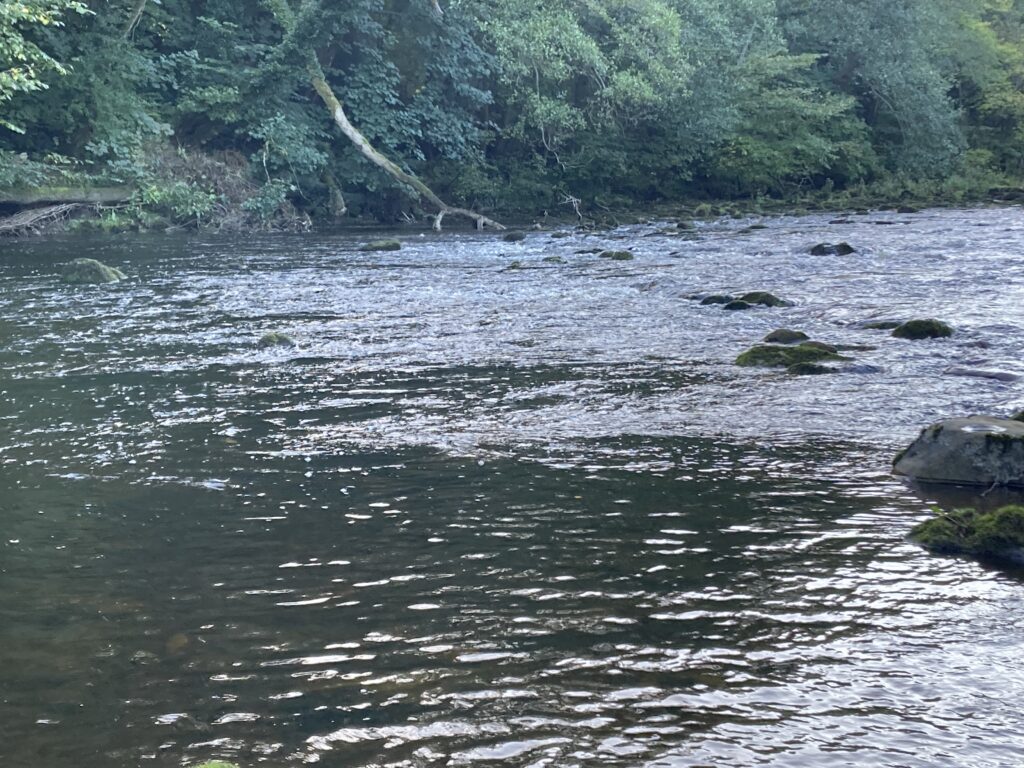
Faith was rewarded. Five more good trout on the Hydro and two grayling on the Oppo, all barely moving my feet, over a two hour period. I lost or pricked a further three or four fish, though this did not spook the rest of the shoal, which was something of a surprise. The lesson learned, or consolidated, though, was that if the water is right – where fish might be expected to be – then with the approach appropriate for the type of water, you can have confidence, and there is no point in moving on.
The next day, I explored the waters around Lower Island and Slee Ghyll. There were rises, although only a scatter of Pale Wateries. There were a lot of midges in the air, however, so I reasoned that these were what the grayling were taking. It was a day for dry fly on this open section of mainly flat water, and because of the tiny food forms I chose the size 20 Plume Tip.
These lower beats offer easier wading, but I moved very slowly, because it is all too easy to send bow waves out into the river and spook rising fish, even way beyond casting range. The shallow water is almost exclusively along the right hand bank. Here there is an almost continuous shoal of first year group grayling (and minnows). From about a third the way across the stream you can expect better quality grayling, with trout mostly close to the far bank, where there is considerable feature in the way of overhanging trees along with woody debris and boulders from the steep bank.
It was fascinating as I worked my way upstream, ‘mapping’ the water, finding grayling concentrated in some locations, with trout in others. The Plume Tip was devastating, and I experienced very few of the ‘fresh air’ rises that plagued me during my spring visit. There were also bursts of activity, when several fish came close together. These coincided with more Pale Wateries being seen. With the trout season drawing to a close, it was good to be able to better target the grayling with their distinctive, subtle rise forms.
On my final day, Robert dropped me off at Sandy Bed Stream towards the top of the beat. Here, I was utterly alone in this Scottish-like gorge and eager to find grayling. Like Mowbray, there is a distinct run-in here from the boulder field of Hell Hole above, and the water breaks over a sand and gravel bed, forming another distinct foam line. The wading is good here, mostly on sand, and I was able to spend the morning methodically searching the area. I had noticed a few caddis in the air, and also egg laying on the calm water towards the pool tail, so I put up a size 16 caddis-style Plume Tip.
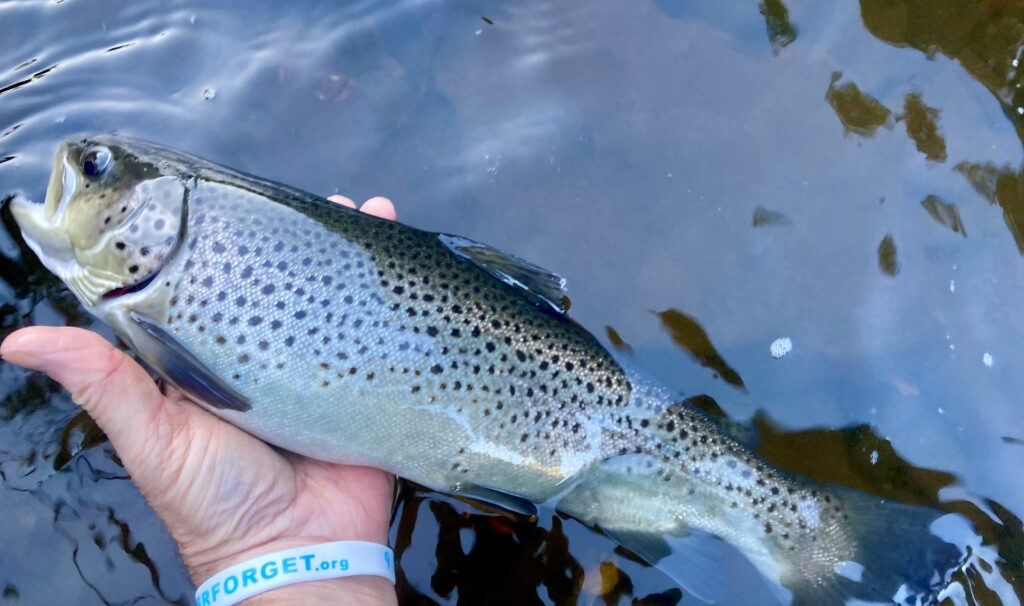
With very few rising fish to be seen it was again a matter of faith – putting an appropriate fly on the broken water and foam lines, where grayling are expected to be. And so it proved, with six grayling and a solitary trout. Interestingly, the trout came from near the pool tail, whereas the grayling were all from the run-in area; a lovely example of how there is minimal competition between these species for their habitat niches.
For three days, I fished alone, not seeing a single other angler, on water that was simply unpressured. I wonder how many members get out on the Tanfield beats through the grayling season. I strongly recommend it, however; this species gives the fly fisher a different and rich experience of the river. You might catch on dry fly throughout the winter, though a nymph approach will be more consistent. If you choose your water carefully, there will be little need to wade far out. This will keep you from disturbing the trout and salmon redds as well as considerably reducing the danger of deep wading.